I asked an agent to make a cartoon in Moho
I own a copy of Moho, the 2D animation app, so I asked Claude Code a hypothetical: could it drive Moho to make short cartoons?
About eight minutes later I had Pip, a small round-headed character who walks onto a hillside and waves. About thirteen minutes after that, Pip could talk, using voice models running on my laptop. No paid voice API, no subscription for the voices.
All the art in that video came out of code. Claude picked the shapes, coordinates and colors, with no character library or image generator. It’s simple, and it looks simple, but it’s a real Moho project with bones and keyframes.
My part was small: I said “yes, try it” a couple of times, listened to the results, and re-ran the scripts once myself. The rest was Claude.
The first plan lost to testing
Claude’s first answer listed four routes and ranked Lua, Moho’s official scripting language, as the best. Command-line rendering and writing the project file directly came lower, marked untested, and clicking through the app was the slow fallback. It said up front that none of this had been tested. Then it tested it, and the order flipped. It never ran a line of Lua.
A .moho file turned out to be a zip holding a JSON project and a preview image, and Moho’s command-line renderer worked:
/Applications/Moho.app/Contents/MacOS/Moho \
-r wave.moho -f PNG -o frames/f -start 1 -end 120 -vSo Claude didn’t need to touch the app’s interface. A Python script of about 600 lines writes the project: 14 bones, 22 art layers and the keyframes. Moho renders PNGs, and ffmpeg encodes them. The format isn’t documented as far as I can tell, so the script copies its empty building blocks out of a tutorial Moho ships, and a Moho update could break it. I haven’t published the script.
The first working 5-second version took 2.7 seconds to build, render and encode. It also looked like this:

White sky, because the project’s background color doesn’t reach the PNGs, which are transparent there. A hand over Pip’s face. Crossed legs. Claude spotted all three in a grid of sampled frames, and the final version was done about 75 seconds later.

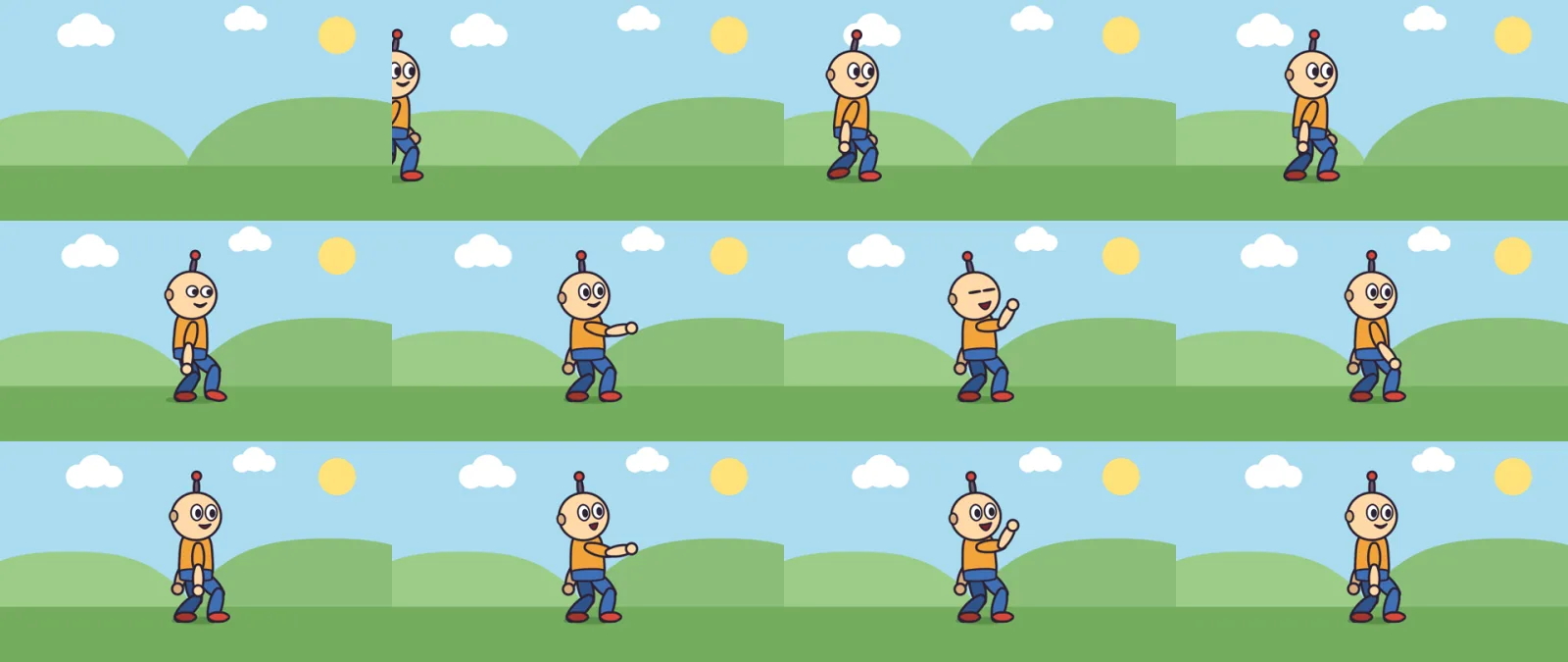
That grid is how Claude reviews its work. It looks at still frames, not playback:
Opened in Moho, it looks like a normal project: bones over the artwork, named layers, keys along the timeline.
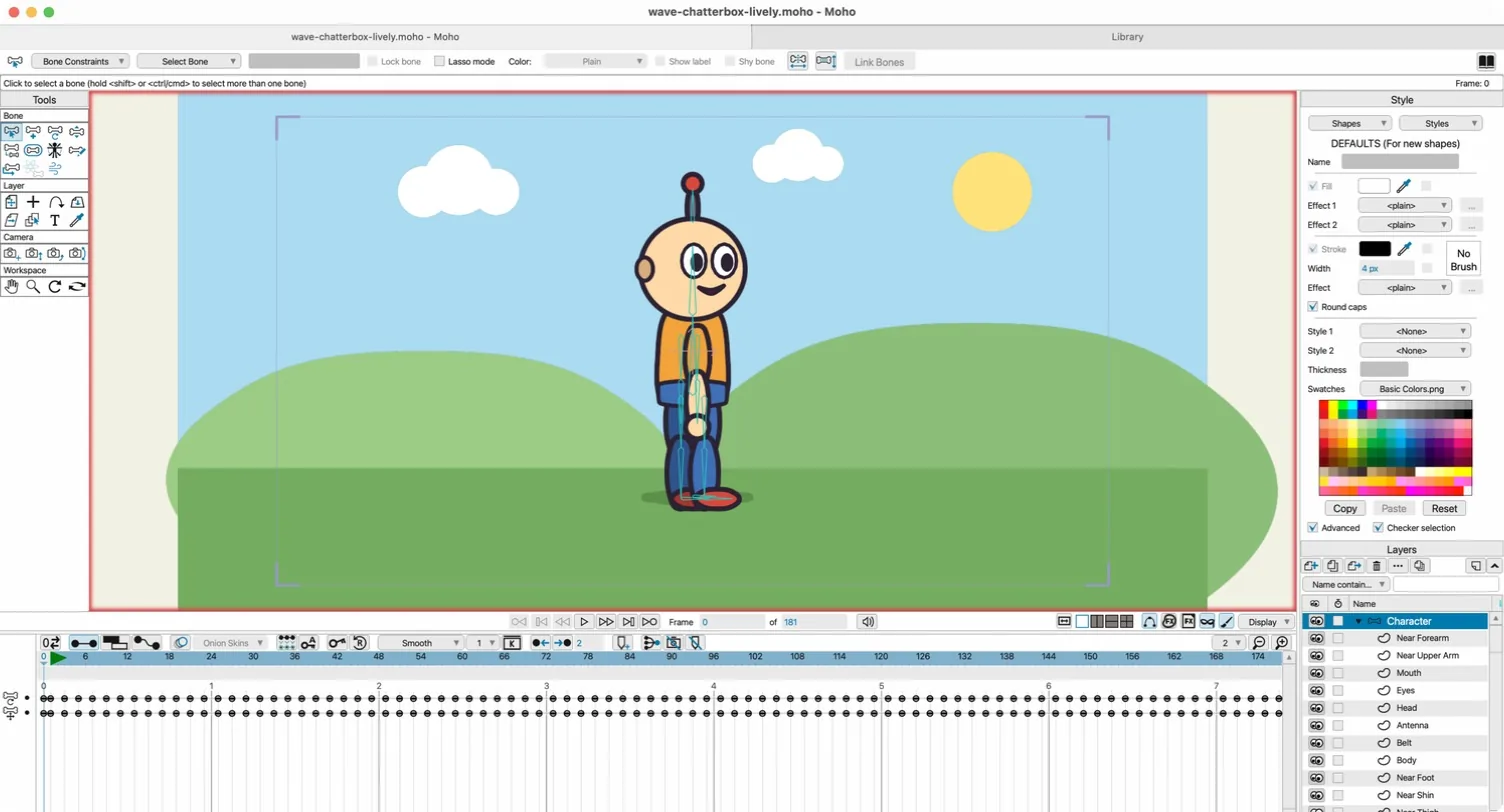
That suggests a person could pick up where the agent stopped, but I haven’t tried moving a bone yet, so I can’t promise it. Two things will get in the way: there’s a key every 2 frames, and the audio is only in the MP4, not in the project.
Update, November 4, 2026: I’ve now tried it, with Claude making the change through full-screen control. On a copy of a generated project, it changed a forearm bone by hand at frame 30. Moho added a keyframe and saved the file, and the command line rendered the change. That’s one bone, not a full editing session.
Free voices and lip sync
I asked whether we could skip paid voice APIs. We could. Claude tried two open models through mlx-audio, running locally on Apple Silicon:
| Kokoro | Chatterbox (4-bit) | |
|---|---|---|
| Voices | 54 presets (we used one) | One default; cloning from a clip untested |
| Emotion setting | No | Yes (we varied it; effect not judged closely) |
| Time for this 4-second line | About 3 s | About 5 s |
| Disk | 684 MB | 1.2 GB |
| Peak memory | About 2.9 GB | About 3.8 GB |
| License | Apache 2.0 | MIT upstream; this build listed Apache 2.0 |
Here are the voices on their own:
am_puck: “A script drew me…”Moho also bundles Rhubarb Lip Sync, inside the app at Contents/Resources/Rhubarb/. It turns a WAV file into timed mouth shapes:
rhubarb -f json -r phonetic -d dialogue.txt -o mouth.json line.wavClaude drew a mouth pose for each shape and keyed them onto one 6-point outline, then made the head nod and the arm rise on the last word of each take.
When I re-ran an existing line myself, from text to finished video, it took 11 seconds. Only the first run of each model was slow: nearly 14 minutes for the Chatterbox download.
I listened to both voices and thought they sounded pretty good. The Kokoro and calmer Chatterbox videos use the same words, so they’re the fair comparison:
What it got wrong, and what we haven’t checked
It can’t hear, and it can’t watch. This is the big one. Claude has no idea whether a voice sounds good, and it reviews sampled frames rather than playback, so it told me it couldn’t vouch for the timing. Its stand-in for ears was running Whisper over the audio. Whisper kept transcribing “A script drew me” from Chatterbox as “script roomie” or “script from me”:
One combination of settings got a clean transcript of the audio, and for the livelier take Claude changed the line to “A script made me.” But Whisper wobbled too, reading the same audio differently once it was in the video, so it’s a rough signal. It might point at a muddy word, on this 4-bit build at least. It can’t tell you a performance is any good, and neither of us has judged the lip sync closely.
It wrote down a claim from indirect evidence. It ran three takes each of three variants. Within each group the lengths, loudness and transcripts matched, so it concluded retakes were identical and put that in a script comment. Then it compared the files, found they differed by about -112 dB, far too little to hear, corrected the comment and told me. The practical conclusion held: re-running won’t get you a new performance, you have to change a setting. But for about a minute, the claim sat there as fact without having been checked.
It said it couldn’t inspect the project in Moho. Screenshots of the window failed within seconds of opening it, so it told me it had never seen the rig. A retry while writing this post worked, which is where the screenshot above came from. Clicks on the canvas were refused while Moho was in the background. Full-screen control might get past that; we didn’t try. (Update, November 4, 2026: we tried, and clicks and drags on the canvas worked.)
Moho called the file corrupt over a number. The very first build failed with Unable to load document (corrupt). Claude bisected it: a whole number in a field Moho expects as a float rejects the entire file. -1 fails, and -1.0 loads.
Video export never worked from the command line. Eight format names passed to -f, including MP4 and H.264, each produced a 0-byte file, and one printed Could not allocate video frame. With no -f, Moho wrote a JPEG sequence. These were guesses, so a right answer may exist. PNGs and ffmpeg were good enough, so Claude stopped looking.
Update, November 4, 2026: a right answer does exist, and this was our mistake, not Moho’s. Video needs the container in -f and the preset in -options, as in -f mp4 -options "MP4 (MPEG4-AAC)" on Moho 14.4 or -f mp4 -options "MP4 (H.264-AAC)" on 14.5. I found that by starting an export in Moho’s window and reading the command it launched. A missing or wrong preset crashes Moho with no message and leaves a 0-byte file named without its extension. My test project has no audio, so I haven’t checked sound this way.
A package installed itself. On first run, mlx-audio installed spaCy’s en_core_web_sm from GitHub on its own. It came from spaCy’s official models repo, and Claude reported it, but it wasn’t in our requirements.txt, and that file doesn’t pin versions either. Fix both before using this for anything real.
The small stuff. It estimated Kokoro’s download at about 330 MB, and it’s 684 MB on disk. It gave me commands without a cd, which failed in my shell twice. And one Chatterbox limit is still open: the audio starts at full volume with no lead-in, so the “H” in “Hi” may clip.
A file format can be an API
What I’d take from this has little to do with Pip. A desktop app with a readable file format and a command-line renderer is something an agent can build on directly. I’d expect clicking through the interface to be slower and more fragile, though we never tried it. It’s a brittle foundation, since one Moho update could end it, but for a short cartoon it was enough.
Claude called the limits in its first answer, while getting the route wrong: geometric art, stiff acting, and better results if someone who can draw makes the rig while the agent does the animating.
Tested on an M2 Pro MacBook Pro with 16 GB, macOS 27.2, Moho 14.4, mlx-audio 0.6.4 and Rhubarb 1.12.0.
If an agent can do the mechanical parts of a cartoon but can’t hear the voice or watch it play, how much of animation was ever the mechanical part?