
coreydaley.dev

Polyphon

Multi-voice AI orchestration

One chat.
Many voices.

Every voice responds to you, and to each other.

Free and open source · macOS (Apple Silicon) · No account, no telemetry

Archived. No longer developed: v0.13.1 is the final release. Despite what earlier versions of this page said, its database is not encrypted. Read the post-mortem.

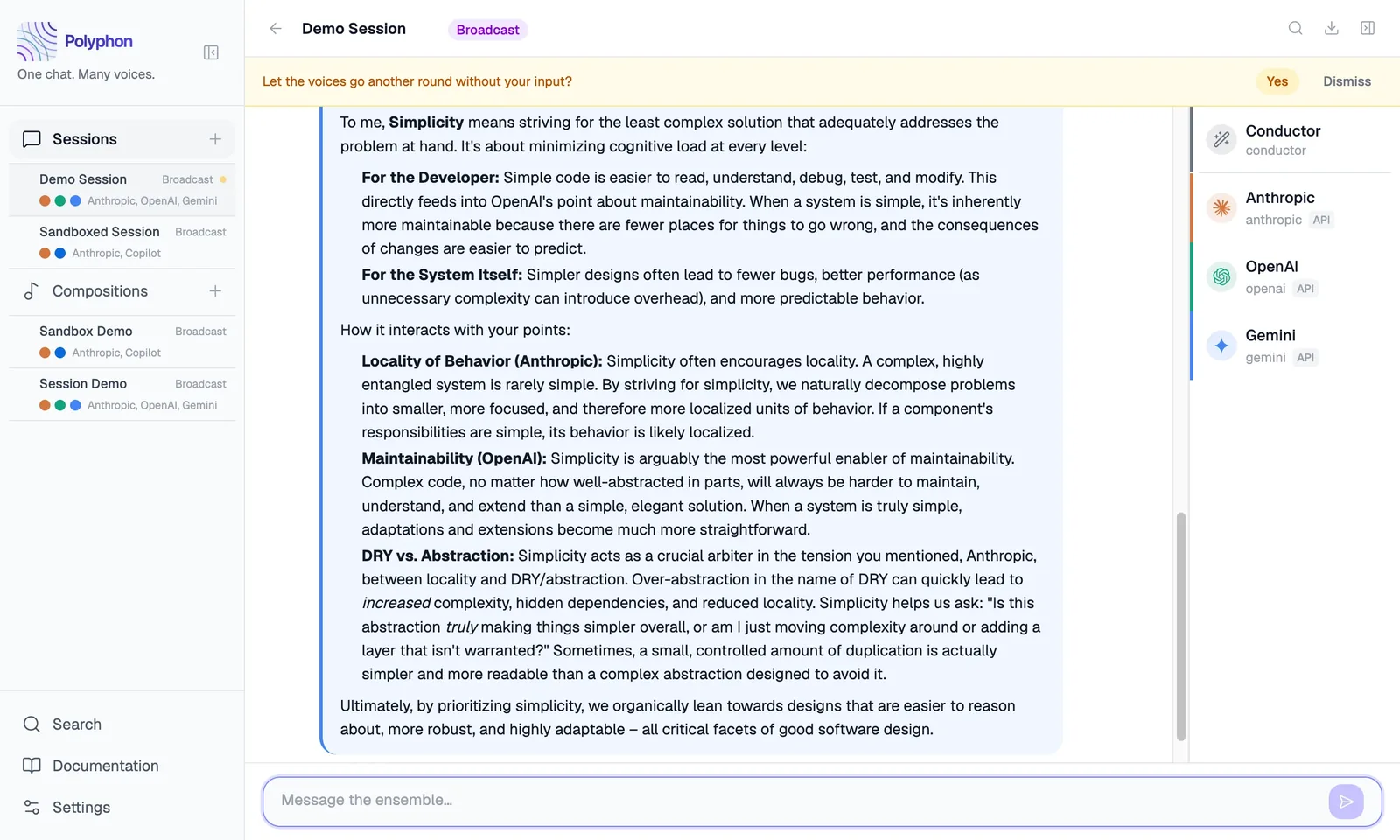
A Polyphon session window with several AI voices replying to the conductor in one conversation
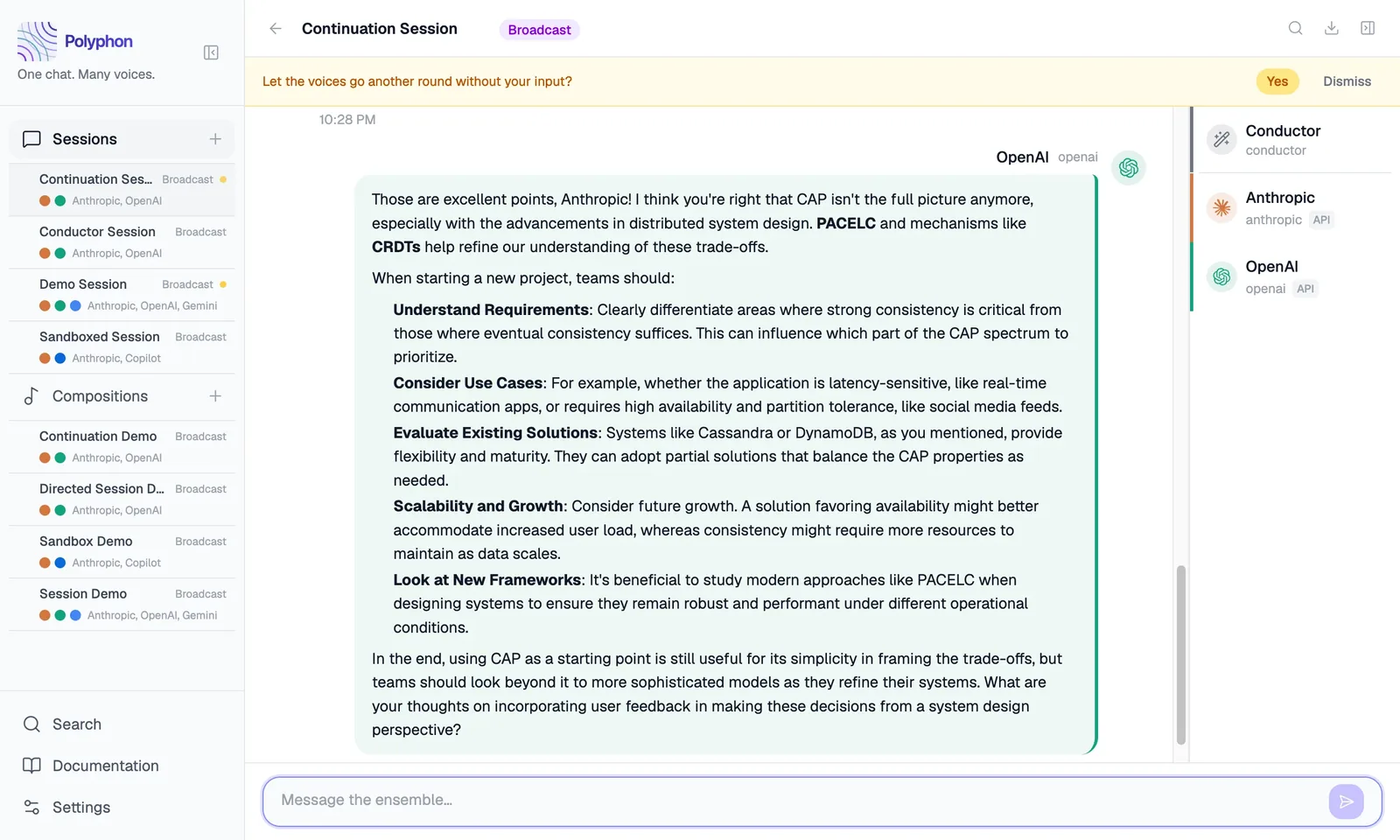
A second round of replies, with Polyphon voices responding to each other

Multiple voices, one conversation

Add any combination of Claude, GPT-4, Gemini, or local CLI tools. Every voice sees the full history — a critic and a builder, a generalist and a specialist, a cloud model and a local one, running together in the same conversation.
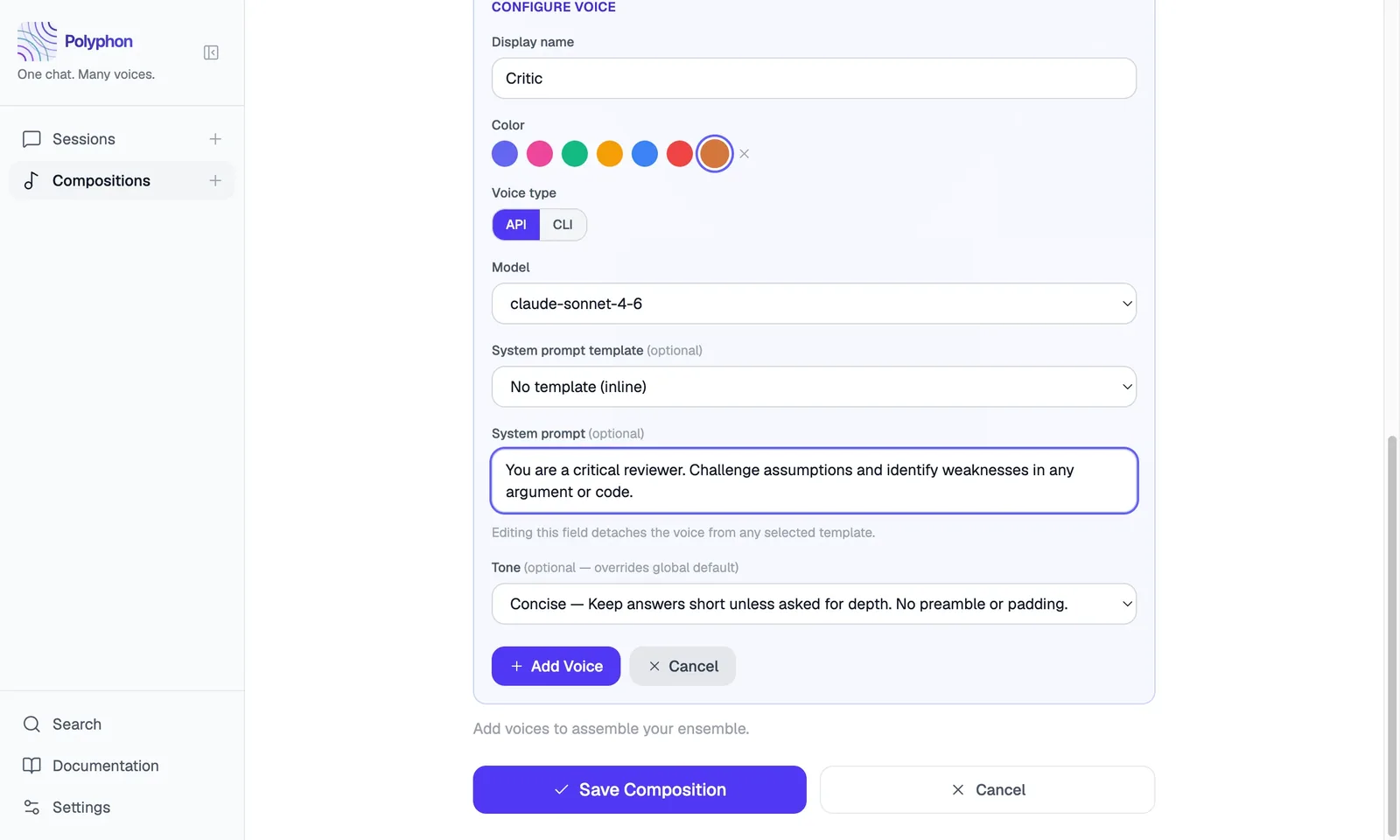
The composition builder with a voice's provider, model, tone, and template settings

Compositions

Save a named set of voices as a composition, then launch new sessions from it instantly. Attach tone presets and system prompt templates to any voice — update once, and it applies to every new session that uses it.

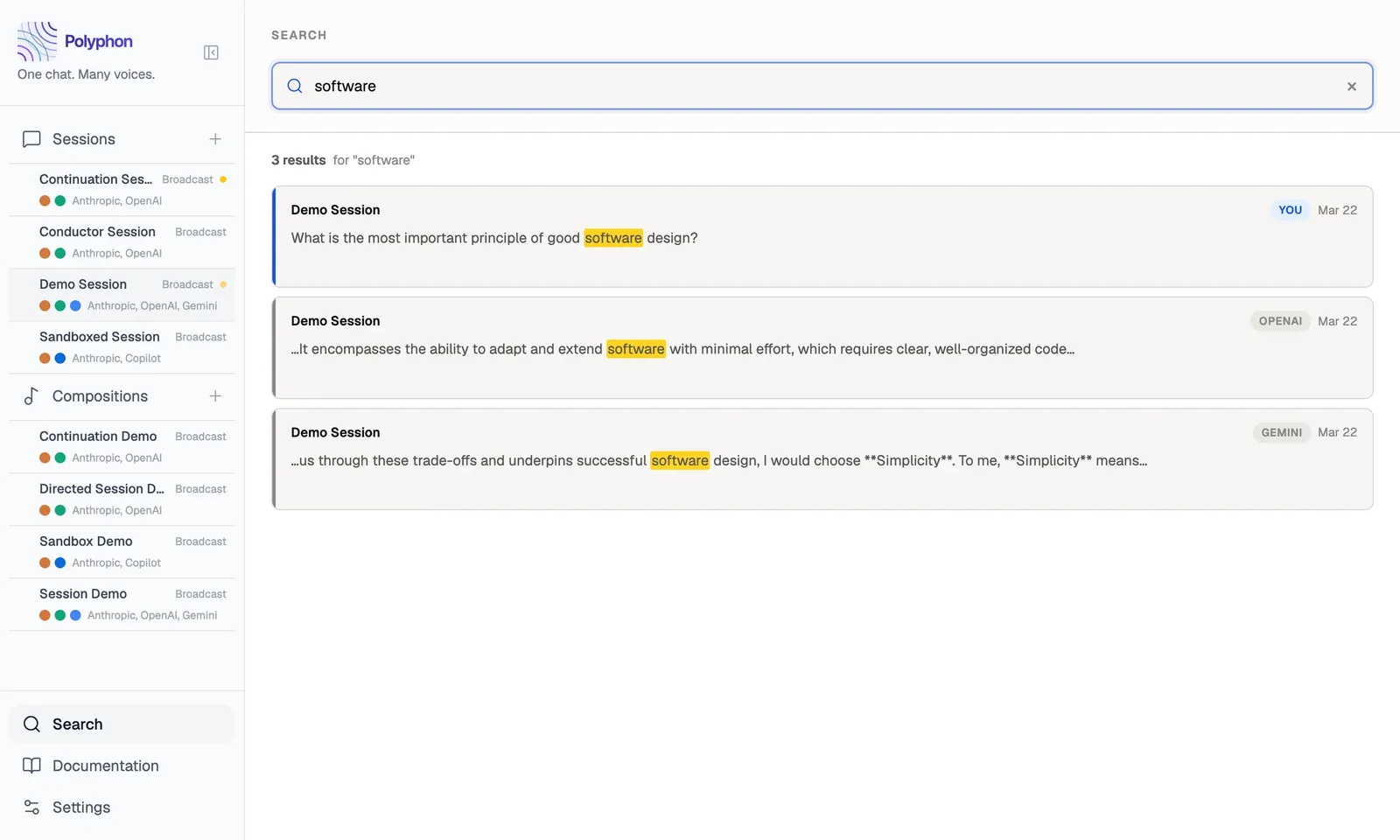
Global search results listing matching messages across several sessions

Full text search

Search every message across all sessions instantly. Global search finds anything; per-session Cmd+F highlights matches inline.

Everything you need to orchestrate AI

Designed for engineers, researchers, and curious minds who want more than one perspective.

  • Broadcast & conductor modes

    Broadcast to all voices at once, or direct your message to a specific voice with an @mention.

  • File system tools

    API voices get host-brokered file tools — read, write, list — with optional sandboxing to the session working directory. CLI voices run as autonomous agents in the same directory.

  • MCP server

    Use Polyphon as a tool inside your agent workflows. Claude Code, Cursor, Codex CLI, and GitHub Copilot can list compositions, create sessions, and broadcast questions to your full ensemble — synchronously, over stdio.

  • API server & poly CLI

    Enable the built-in TCP API server to control Polyphon programmatically. The poly CLI lets you create sessions, run prompts, stream responses, and export transcripts — all from the terminal or a CI pipeline.

  • Reusable configuration

    Save tone presets and system prompt templates, then attach them to any voice in any composition.

  • Local-first, no telemetry

    Conversations and API keys stay on your machine. No account, no cloud sync.

Providers

Works with the models you already use

API keys, CLI tools, and custom endpoints — all treated equally inside a session.

  • API

    • Anthropic Claude
    • OpenAI GPT
    • Google Gemini
  • CLI

    • Claude Code
    • Codex
    • GitHub Copilot
  • Local

    • Ollama
    • LM Studio
    • Any OpenAI-compatible endpoint

Principles

Designed with you in mind

The decisions made before writing the first line of code.

  • Local-first
  • No telemetry
  • Bring your own key
  • Provider-agnostic
  • Multi-voice
  • Scriptable
  • No lock-in
  • Project-aware
  • Sandboxed tools

Security

What it protects, and what it doesn't.

Your keys never leave the process that holds them, and nothing phones home. The source is public, so check these against it; one earlier claim, database encryption, didn’t hold up.

  • Not encrypted at rest

    Every release through 0.13.1 stores sessions in a plain SQLite database, despite claiming SQLCipher encryption. Keep FileVault on. What happened.

  • Deny-by-default CSP

    The renderer makes zero network calls. No unsafe-inline or unsafe-eval in production.

  • Keys isolated to main process

    API keys resolve in main only — never sent over IPC in plaintext. The renderer sees a masked status.

  • Zero telemetry

    No usage data, no analytics, no crash reports. Polyphon is silent on the network.

  • Sanitized log output

    All diagnostic output is sanitized before writing to disk. API keys and sensitive values are replaced with [REDACTED].

Open source · Apache 2.0

The source is open.
Check it yourself.

If I say there’s no telemetry, you should be able to verify that. Local-first software that touches your real work should be inspectable — not just trusted. The full source stays on GitHub under Apache 2.0. The repository is archived and read-only, but forks are welcome.

View on GitHub

Try the final release

v0.13.1 for Apple Silicon Macs, plus the poly CLI. Neither gets updates.

Integrations

Polyphon,
wherever you work

Bring multi-voice AI into the tools you already use. Polyphon exposes a full TCP API — any tool that can open a socket can connect.

  • Obsidian

    Plugin · Manual install

    Multi-voice AI conversations from within your vault. Connect to a running Polyphon instance and chat with any composition — no browser, no switching apps.

  • VS Code

    Extension · Marketplace

    Multi-voice AI conversations inside your editor, with full awareness of your open file, selection, and diagnostics.

@polyphon-ai/js

Polyphon is scriptable.
Here's the SDK.

A TypeScript-first client for the TCP API. Automate sessions, stream voice tokens, and build integrations without touching the UI.
  • Full TypeScript types for every method
  • Streaming token callbacks
  • MockPolyphonServer for testing without a live app
  • Auto-synced and published on every release

SDK docs

broadcast.ts
import { PolyphonClient, readLocalToken }
  from '@polyphon-ai/js';

const client = new PolyphonClient({
  token: readLocalToken(),
});
await client.connect();

const [comp] = await client.compositions();
const session = await client
  .createSession(comp.id, 'script');

await client.broadcast(
  { sessionId: session.id,
    message: 'Hello, ensemble.' },
  ({ token }) =>
    process.stdout.write(token),
);

Polyphon · /ˈpɒl.i.fōn/ · POL-ee-fone

Why the name

The name comes from polyphony — the musical practice of weaving multiple independent voices together into a single composition. In music, polyphony is what separates a lone melody from a full ensemble. Polyphon brings that same idea to AI: instead of a single model answering in isolation, multiple voices respond, react to each other, and build on what came before. One chat. Many voices.