coreydaley.dev

Attractor

DOT-based AI pipeline orchestration

Multi-stage AI pipelines,
drawn as Graphviz graphs.

Describe the shape of the solution as a graph. Attractor pulls the work toward it, through retries, branches and failures.

Open source · Apache 2.0 · Kotlin on the JVM

Archived. No longer developed. A learning project, kept up for reference.

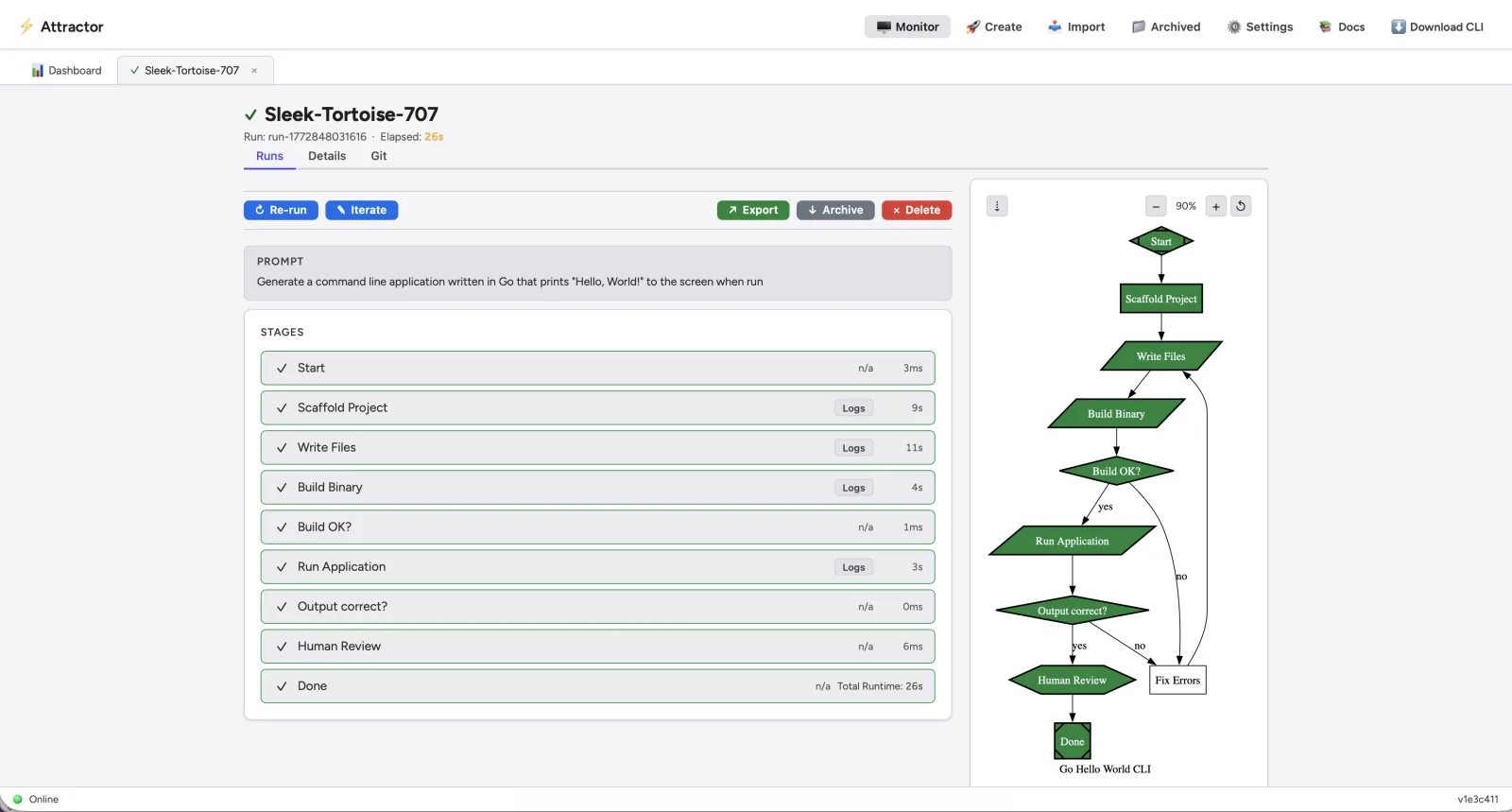
Attractor Monitor view of a completed run, every stage checked green beside its rendered pipeline graph
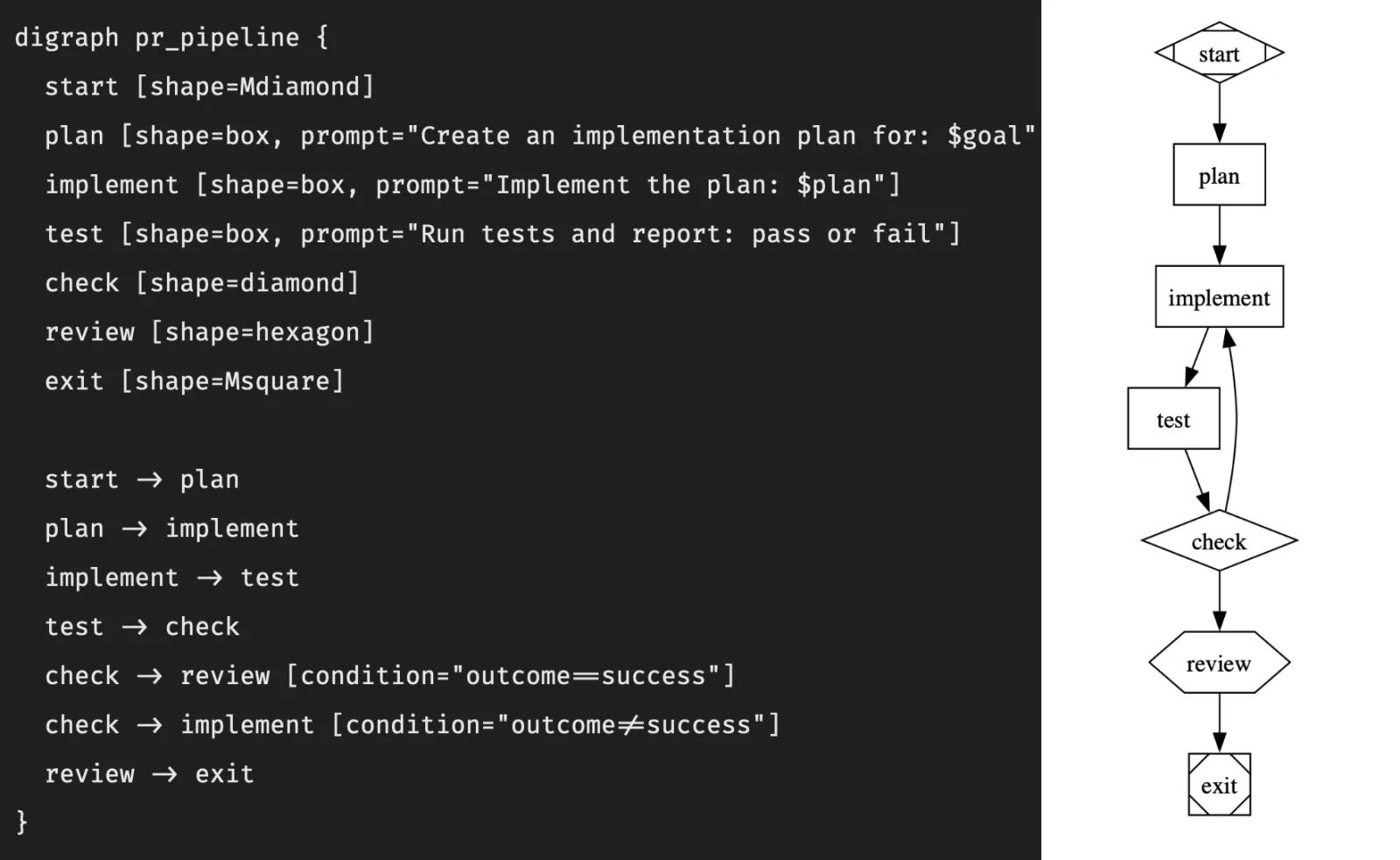
DOT source for a PR pipeline beside its rendered graph: start, plan, implement, test, check, review, exit

Pipelines are DOT graphs

Nodes are tasks and edges are transitions. A node’s shape tells the engine what to do: box sends a prompt to a model, diamond routes on edge condition= expressions, and hexagon pauses for a human. If you’ve drawn a diagram with Graphviz, you already know the format.

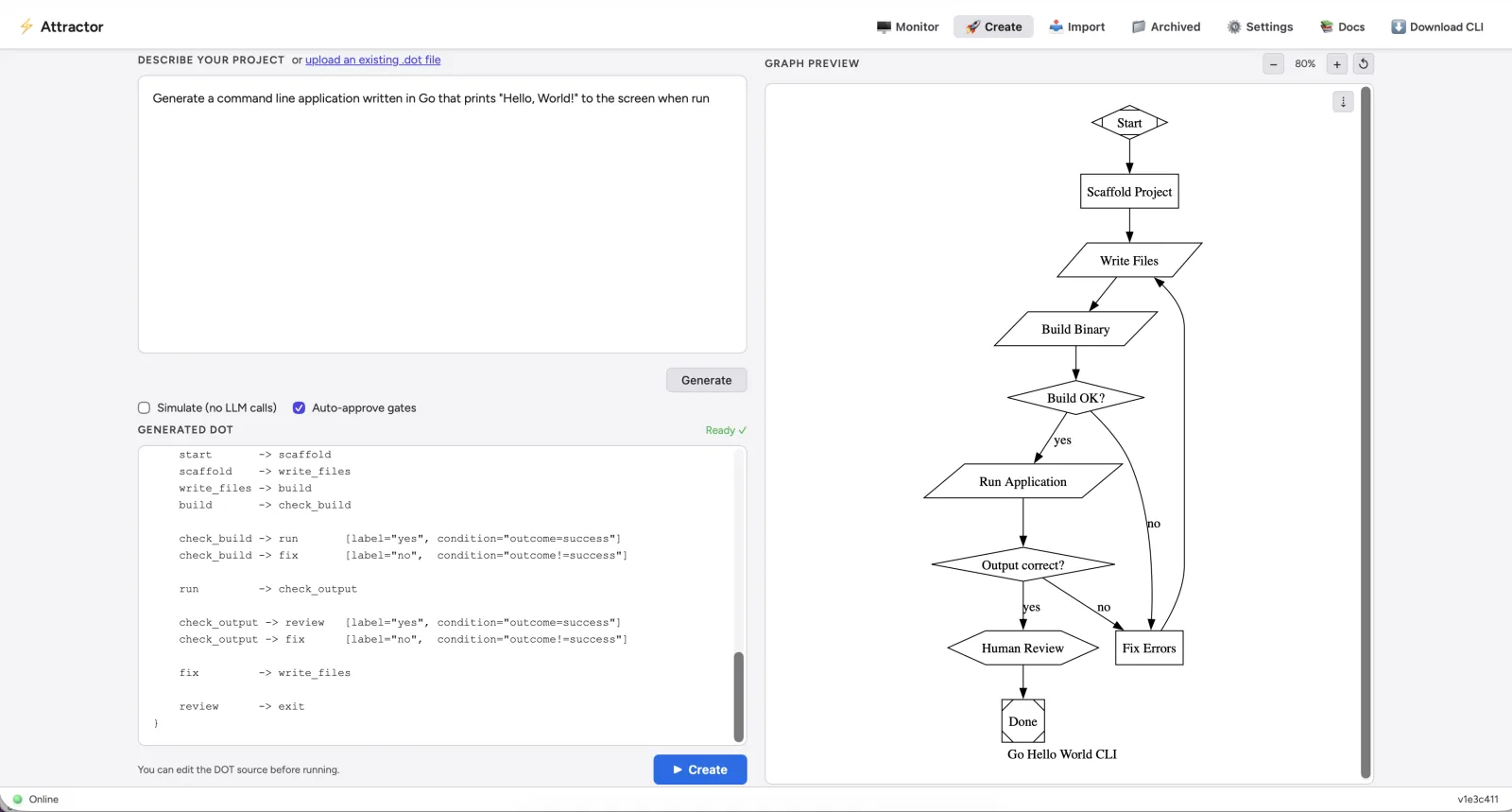
Attractor Create view with a plain-English prompt, the generated DOT source and a live graph preview

Describe it, then run it

Write the goal in plain English and Attractor generates the DOT pipeline, validates it and previews the graph. Edit the source before you run, or upload an existing .dot file.

What it does

A small engine with the pieces a long-running AI pipeline needs.

  • Conditional branching

    Edges carry condition= attributes that route execution on each node’s outcome, so failed tests loop back to implementation.

  • Parallel execution

    Fan-out and fan-in nodes run several branches concurrently, then join the results.

  • Human gates

    wait.human nodes pause the run until someone approves, rejects or routes it down a revision path.

  • Retry and resume

    Per-node retry with exponential back-off. Run state persists to SQLite, MySQL or PostgreSQL, so crashed runs resume from a checkpoint.

  • Live dashboard

    A real-time, SSE-powered web UI on port 7070 for watching concurrent pipelines, uploading .dot files and browsing artifacts.

  • REST API and CLI

    A versioned REST API at /api/v1/ and an attractor CLI for managing pipelines, artifacts and DOT graphs from scripts.

LLM providers

Bring the models you already use

Call providers directly with API keys, or shell out to the CLI tools you already have installed.

  • Direct API

    • Anthropic Claude
    • OpenAI GPT
    • Google Gemini
  • CLI subprocess

    • Claude Code
    • OpenAI Codex
    • Gemini CLI
    • GitHub Copilot
  • Local

    • Ollama
    • LM Studio
    • vLLM
    • Any OpenAI-compatible endpoint

Quick start

Three commands
to a running dashboard.

Attractor needs Java 25, git and Graphviz. The first make target installs them interactively for your OS; then build and open http://localhost:7070. Prefer containers? Images are published to the GitHub Container Registry and run with Docker Compose.
  • SQLite by default; MySQL or PostgreSQL via ATTRACTOR_DB_*
  • Compose profiles for Ollama, PostgreSQL and Docker-out-of-Docker
  • API keys come from the environment, never baked into images

Web app guide Docker guide

terminal
git clone https://github.com/coreydaley/attractor
cd attractor

make install-runtime-deps  # Java 25, git, graphviz
make build
make run                   # http://localhost:7070

# or, with Docker Compose
cp .env.example .env       # add your API keys
make docker-up

Credit · Status

Based on StrongDM's Attractor.
Archived.

Attractor is based on the work of StrongDM’s Software Factory and their Attractor project at its core. The Software Factory is an automated development system where AI agents write code, run validation and improve continuously, and Attractor is its graph-driven orchestration engine. This repository is my personal implementation of that idea, built in Kotlin as a learning project to explore agentic workflow orchestration. The codebase was generated by AI; review it before you rely on it.

The repository is archived and Attractor is no longer actively developed. The source and docs stay available under Apache 2.0.

View on GitHub Read the blog post

Why the name

A state the system converges toward

In dynamical systems theory, an attractor is a state or pattern that a system naturally settles into over time, however turbulent the path. Attractor applies that idea to agentic pipelines: rather than scripting every step imperatively, you define a goal-oriented graph and let execution converge on it, even across retries, conditional branches and partial failures. The pipeline is the attractor.