Building Apple apps with AI agents
How I build and ship Mac, iPhone and iPad apps with AI coding agents, mostly without reading the code: the workflow, testing, App Review and audits.
I’ve shipped two apps to the App Store this way: Purrchiver, a Mac archive utility, and Secret Store, a secrets manager for the Mac. AI coding agents (Claude, through Claude Code) wrote almost all the code. I mostly don’t read it. My job is deciding what the app must and must never do, proving it works, and turning every mistake into a rule the agents read next time.
This isn’t just a side-project habit. It’s how I work at my day job too: building with AI agents, with the deciding and the checking still mine. The apps are where I can show the details.
This guide collects what that takes, from the workflow to the tests, audits and App Store rejections that shaped it. Each page links to the post where the details are.
The numbers
| Purrchiver, first commit to Mac App Store | 33 days (May 20 to June 22, 2026) |
| Purrchiver commits to date | more than 1,000, of which about 96% have a Claude co-author |
| Secret Store commits to date | 184, about 95% with a Claude co-author |
| Purrchiver automated tests | more than 1,800, including about 180 UI tests |
| Rejections | one App Review rejection (two guidelines) and one upload rejection, each now a check in the shipping checklist |
| Pre-1.1 audit sweep (Purrchiver) | 12 audits in about an hour and a half, 79 issues filed, 72 closed so far |
The commit figures run to late October 2026. At Purrchiver’s 1.0, the co-author share was about 94%.
Not just the apps
My open-source projects were built the same way, and the commit history shows it:
| Project | What it is | My commits with a Claude co-author |
|---|---|---|
| Polyphon | Desktop app for conversations with several AI voices at once | about 86% of 577 |
| Attractor | Runs multi-stage AI workflows defined as Graphviz graphs | 151 of 153 |
| agent-config | The skills this guide describes | about 86% of 196 |
| MessagePit | Email and SMS testing tool, a fork of Mailpit | all 37 of my changes on top of Mailpit |
They aren’t Apple apps, but the lessons carried over, including the painful ones: Polyphon’s tests checked a different build from the one that shipped.
Fixes that went upstream
Purrchiver is built on libarchive, the open-source library behind many archive tools. Its tests found bugs in libarchive itself, and those went back to the project:
- Multi-part RAR5 archives stopped reading in 3.8.10. Found by the multi-part tests and reported; libarchive fixed it.
- A cpio archive lost every file, with no error, after a few bytes of junk. Found by the damaged-archive tests; our fix was merged.
- Stored RAR and RAR5 files weren’t checked against their CRC, so a damaged file read back as intact. Found by the damaged-archive tests; our fix is proposed.
- In a password-protected ZIP, libarchive wrote symlink targets in plain text, so anyone could read where each link pointed without the password, and it couldn’t read symlinks that 7-Zip or Info-ZIP had encrypted. Reported; our fix is proposed.
- The gzip reader never checked a file’s CRC, so damage that decompression didn’t notice read back as intact. Reported; our fix is proposed.
- ZIPs made by Finder’s Compress with a file over 4 GB stopped reading in 3.8.9. Reported while making Purrchiver read them.
Purrchiver also proposed read support for two formats libarchive can’t
open: Outlook’s winmail.dat and StuffIt. The current status of each is on
Purrchiver’s open-source page.
The fixes were written the same way as the app: by the agents, checked by tests, with the decision to send them upstream mine.
The loop in one paragraph
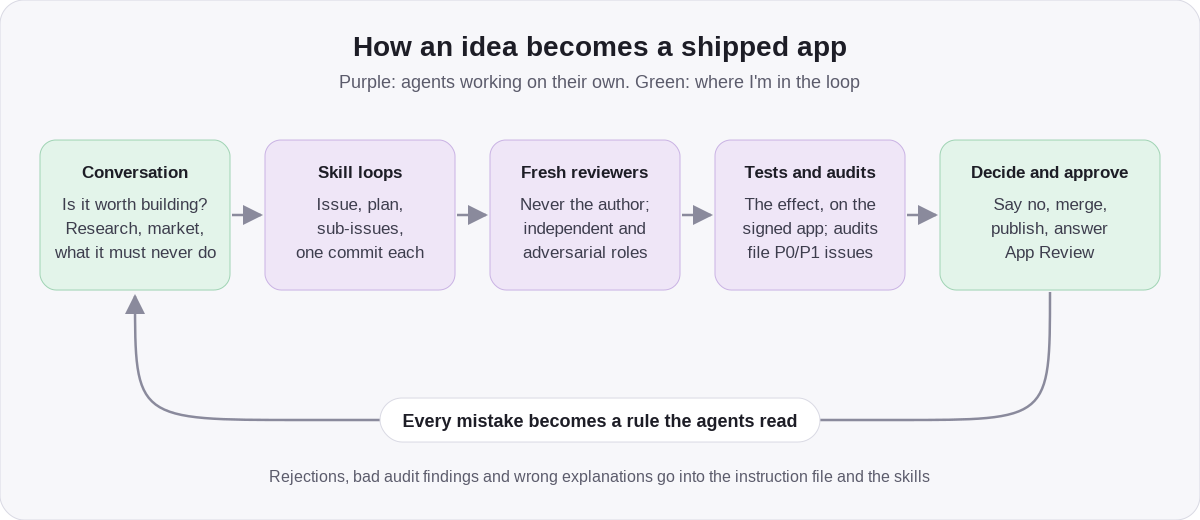
Everything starts as a conversation with an agent, the app ideas included: the agent researches the market and what’s already out there, answers questions about how it could be built, and helps decide what’s worth building at all, what the app should do and what it must never do. What we settle on goes into the skill loops. The feature skills turn it into a GitHub issue, a plan of sub-issues and then commits; the PR skills plan, build and review single changes. The lines the app never crosses go in the instruction file every agent reads. Separate review agents, which never wrote the code, check it. Tests check what the user would actually see, on the signed app. Audits look for what nobody asked about. The agents also write the marketing, the help pages and this site, make the App Store assets and test on devices. What’s mine is deciding, approving and saying no. Then every rejection, bad audit finding or wrong explanation becomes a rule.
“The AI writes; the human checks.” From empty repo to App Store in 33 days.
The pages
- From issue to App Store: the skills, the review agents, and why the reviewer is never the author.
- What’s still mine: the agents do nearly everything; what’s left is deciding and approving.
- Testing code you don’t read: test the effect, test the signed binary, and the Apple test traps.
- Shipping checklist: pre-submission checks drawn from real rejections.
- Audits: the 22 Apple audit skills, what they cover, and how findings become work.
The skills are public in my agent-config repository; the app code isn’t.