Auditing an Apple app with AI agents
Tests check what you thought to ask. Audits look for what you didn’t: a security hole, a missing privacy declaration, a setting that does nothing. My agent-config repository has 29 audit skills, 22 of them for Apple platforms.
How an audit runs
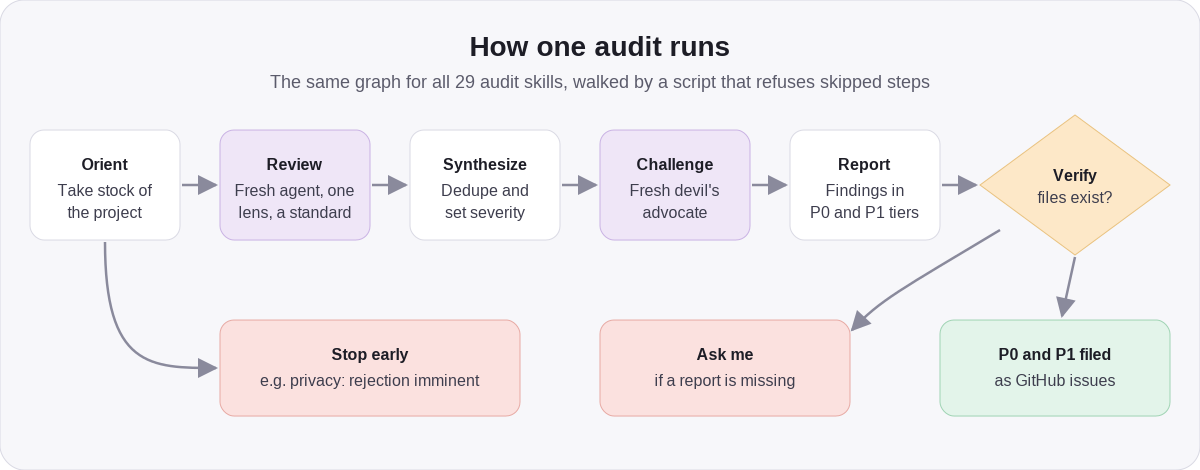
Each audit is the same graph of steps:
- Take stock of the project and its tools.
- A fresh reviewer agent examines it through one lens, such as security or accessibility, against a named standard (App Store Review Guidelines, Human Interface Guidelines, WCAG, OWASP).
- The orchestrating agent dedupes and calibrates the findings, then a fresh devil’s-advocate agent challenges them.
- A report is written, and a verification step refuses to let the audit finish without it.
- P0 and P1 findings are filed as GitHub issues automatically, ready for triage with the same labels as everything else.
Reports go to a reports folder outside the repository. A finding can also be
handed straight to /pr-plan to become a pull request.
The 22 Apple audits
Across platforms: accessibility, adaptivity, App Store review, architecture, build and release, deep links and Continuity, design, extensions, localization, networking, notifications, observability, performance, persistence, privacy, security, StoreKit, testing.
Per platform: iOS, macOS, watchOS, visionOS.
Some stop early: privacy if rejection looks imminent, such as a missing privacy manifest, and security on live credentials. Each audit says when to run it, for example StoreKit before a new product or after a refund or restore bug, and extensions before a release branch or a new extension.
What a sweep found
Before Purrchiver 1.1, on October 20, 2026, I started 12 Apple audits within about 40 minutes: security, testing, macOS, architecture, accessibility, privacy, performance, StoreKit, App Store review, build and release, persistence and extensions. About an hour and a half after the first started, they and a functional pass had produced 79 deduplicated issues: 9 P0, 57 P1 and 13 deferred follow-ups. 72 are closed so far.
Earlier audits found the settings that did nothing and a filename leak in encrypted 7z archives before release (placebo settings), and the StoreKit audit, with testing, found five unlock edge cases before launch (one-time unlock).
What the audits don’t catch yet
None of the audits checks yet for the rejections in the shipping checklist, or for StoreKit tests being run outside a logged-in session. Those are lessons from incidents that haven’t been turned into audit checks yet; until they are, they live in tests and the checklist.